Concept Mapping Together
A collaborative protocol that adapts Joseph D. Novak’s concept maps into a tool for futures design
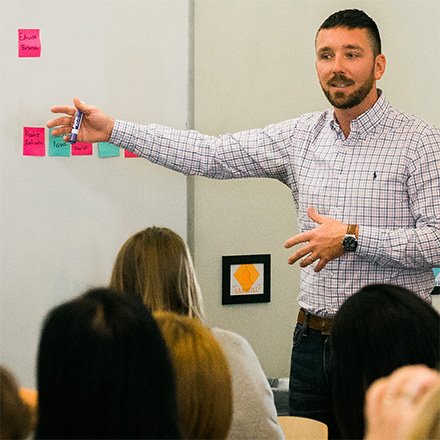
The Workshop
Cooper × Speculative Futures, 2016
The design consultancy Cooper partnered with the Speculative Futures group to introduce Concept Mapping Together, a collaboration method adapted from the cognitive research of Joseph D. Novak for design facilitation.
My Role
Co-led facilitator training
I developed and led the workshop with Kaycee Collins and Phil Balagtas, training expert facilitators to apply concept mapping to futures design.
The Method
Concept maps for speculation
By creating well-formed propositions that define the relationships between concepts, concept mapping extends a designer’s ability to understand — and to be understood.
The Challenge
Speculating about future worlds is hard
Design teams often struggle to master the domain knowledge a problem requires, or to align stakeholders who each hold a different piece of the picture. Concept maps organize that knowledge into clear propositions — Concept + Linking Word + Concept — turning a fuzzy problem space into something a team can see and reason about together.
Unlike mind maps, which often leave the relationships between ideas ambiguous, this method forces clarity by requiring an explicit linking word: “Apples may be red,” rather than simply drawing a line between “Apples” and “Red.”
What the method gives a team
- Elicit expert knowledge with less effort.
- Expose conflicts and spark healthy debate early.
- Highlight knowledge gaps that need further research.
- Generate shared meaning across professional boundaries.
Anatomy
Concepts, linking words, and propositions
Two concepts joined by a linking word form a proposition: “Apples may be red.”
Concepts
Labels for objects or events — “Apples,” “Workshop” — typically written on Post-it notes.
Linking words
Verbs or short phrases written on the arrows that connect concepts — “are,” “may be,” “require.”
Propositions
The meaningful statement formed when two concepts are joined by a linking word — “Apples may be red.”
Because every element is loosely coupled, teams can refine any single piece without dismantling the whole structure. Concepts slide into new positions as understanding evolves, which invites an additive, “Yes, and…” style of collaboration and makes knowledge gaps easy to see.
The Protocol
Four roles for a team of four
The protocol is designed for small teams — ideally four people — each holding a clear role so the conversation stays productive.
The Talker
The subject-matter expert who supplies the knowledge.
The Writer
Interviews the Talker and captures concepts on Post-it notes.
The Mapper
Places the notes on the board and draws the linking words and arrows that form propositions.
The Facilitator
Manages time, materials, and focus.
A session begins by choosing a focus question — say, “How do we improve patient safety?” — then generating a “parking lot” of concepts and arranging them into a hierarchical map. The maps are not precious; they are meant to be messy, divergent, and frequently restructured as the team’s understanding deepens.
The Session
A scaffolded path from practice to speculation
Step 1
Focus-question practice
Teams begin with a concrete, personal question — “What is email to you?” — to master the mechanics of assigning roles and forming propositions in a low-stakes setting.
Step 2
Speculative prompting
Teams then draw random prompts — “discomfort,” “school,” “versatile” — to generate a new focus question, and map a product, service, or system that addresses the resulting problem space.
Step 3
Press Release from the Future
The session culminates in a narrative artifact modeled on Amazon’s working-backwards method, articulating the value and function of the speculative invention the map defines.
Outcomes
Speculative products for the year 2026
Teams used the protocol to design products for the year 2026, bridging abstract future trends and tangible product definitions. A few of the concepts they produced:
Prosthetic lung implant
A bio-integrated implant designed to improve both individual and community health.
Sensory transport device
A device that lets users remotely experience national parks through their senses.
Learning exoskeleton
An exoskeleton that monitors physical and cognitive ability to accelerate how quickly its wearer learns.